



ChatGPT
help me figure out what to do differently and how to cultivate better habits to keep my apartment tidy
Jay, this is incredibly fixable. The pattern I see isn’t “you’re dirty.” It’s that your apartment has too many halfway states and not enough obvious homes. Stuff is stopping mid-journey: shoes near the table, cables on the couch, papers on the floor, clothes on the bed, boxes half-processed, tech gear orbiting wherever you last used it. That means your place is asking you to make a decision every time you put something down. Naturally, you avoid the decision, and then the piles become their own little nation-states. 🏴
The big shift is this: don’t aim for “be tidier.” Aim for fewer decisions.
Your new system should have three rules.
First: every recurring object gets a “home at the point of use.” Not an ideal home. A lazy home. The place where your hand naturally wants to drop it. If shoes end up near the coffee table, put a shoe tray or shoe rack right there, or near the entrance path. If cables end up on the couch, put a cable basket by the couch. If papers end up on the table and floor, put one visible paper inbox exactly there.
Second: flat surfaces need jobs. Right now, the coffee table, couch, bed, side tables, and floor are all acting as “temporary storage.” That’s the root of the chaos. Give each surface one role. Coffee table: active work only. Couch: sitting only. Bed: sleeping only. Floor: walking only. Side table: nightly essentials only. Anything else that lands there is “misfiled.”
Third: create “ugly but legal” holding zones. You need places where things can go even when you don’t have the energy to properly process them. Otherwise the whole apartment becomes the holding zone. The goal is not Martha Stewart. The goal is containment.
I’d make these specific changes.
Near the door or main entry path: create a landing station. One tray for keys/wallet/AirPods/lip balm. One hook or chair-back alternative for the jacket you actually wear. One shoe mat or rack. One tote/basket for “things leaving the apartment.” This prevents the first 90 seconds after you walk in from exploding across the room.
By the couch: create a tech/cable basket. Put chargers, headphones, adapters, camera bits, remotes, dongles, little batteries, and random cords there. Not perfectly coiled. Just contained. Your couch photos scream “tech objects have no home.” Give them one big dumb home and you’ve solved 30% of the visual mess.
For papers: you need exactly three paper places. One Inbox for unprocessed papers. One Action folder for things that require doing, bills, landlord stuff, medical, insurance. One Archive box/folder for things to keep. No papers on the floor. No papers on the bed. No “I’ll just put this here.” Papers are like tribbles. They multiply when left unattended. 🖖
For clothes: you need a better distinction between clean, dirty, and worn but not dirty. That third category is probably killing you. Get a visible “worn once” basket or chair. Dirty goes in hamper. Clean gets folded/hung or goes into a clean laundry basket. Worn-once clothes get one legal place. Not the bed, not the couch, not the floor.
For boxes and packaging: make one outbox/recycling zone. The cardboard and shipping stuff in the photos creates a huge sense of disorder because it’s bulky. Have a rule: boxes get broken down within 24 hours, or they go to one specific “box corral.” Never let them become furniture.
For the bed: don’t start with “make the whole bed beautifully.” Start with one move: pull the blanket/comforter up once a day. That’s it. A made-ish bed changes the room more than almost any other single action. It turns the bedroom from “crime scene after a duel” into “writer lives here, probably eccentric but functioning.” ✨
The habit I’d build is a nightly 10-minute closing shift. Not a clean. A reset. Set a timer. You’re not allowed to deep clean. You only return things to homes.
The order should be:
Trash and dishes first.
Clothes second.
Papers third.
Tech/cables fourth.
Shoes and bags fifth.
When the timer ends, stop. The point is to make tidying normal, not epic. Deep-cleaning is seductive because it feels heroic, but it also teaches your brain that cleaning requires a whole production. You want the opposite: boring, fast, repeatable.
The most important habit phrase is: “Don’t put it down. Put it away.” But that only works after “away” is easy. If putting something away requires opening a drawer, moving three things, remembering a category, or walking across the room, your brain will mutiny. So make the homes almost embarrassingly easy.
I’d do a one-time reset like this:
Get five containers or bags: Trash, Recycling, Clothes, Papers, Tech/Objects. Walk through the apartment once and sort only into those five categories. Don’t make decisions beyond that. Then process each category. Trash out. Recycling out. Clothes to hamper/closet/worn-once basket. Papers into inbox/action/archive. Tech into the tech basket.
After that, buy or repurpose a few containers: one big cable/tech basket, one paper inbox tray, one action folder, one open laundry hamper, one worn-once basket, one shoe mat/rack, one outbox basket, and maybe a small tray on the coffee table for “currently active objects.”
The key is to stop relying on future Jay to become a different person. Design the apartment for actual Jay, writer-brain Jay, project-in-progress Jay, camera-gear Jay, “I just came home and dropped everything like a Starfleet officer returning from an away mission” Jay. The apartment needs systems that catch you when your executive function is elsewhere.
For the next week, don’t try to keep the whole apartment tidy. Just practice these three non-negotiables:
Before bed, do the 10-minute closing shift.
No clothes on the bed or couch, only hamper/closet/worn-once basket.
All papers go into the paper inbox, never loose on surfaces or floor.
That alone will make the apartment feel dramatically more under control. Then we can tune the actual storage layout room by room.
Claude
help me figure out what to do differently and how to cultivate better habits to keep my apartment tidy
Your two hunches are both right, and they feed each other. But looking at the photos, there’s one mechanic underneath all of it: every flat surface in your place has quietly become a drop zone. Both couches, the bench at the foot of the bed, the desk. The moment one thing lands on a surface, it gives the next thing permission, and a surface flips from “usable” to “storage” really fast. So the goal isn’t “clean more often,” it’s making it harder for surfaces to become piles in the first place.
A few specific moves, in order of leverage:
Solve the clothes first. Clothes are on basically every surface in these photos, and most of it looks like the “worn once, not dirty, not clean” limbo category. That pile is the silent killer, because it has nowhere to go. Give it an actual home: a row of wall hooks or one designated valet chair that is only for worn-once clothes. Dirty goes in a hamper, clean gets put away same day, in-between goes on the hooks. That one distinction will clear half your mess.
Defend one couch. A couch buried in stuff stops reading as a seat and becomes a shelf, which invites more stuff. Pick one, clear it, and make a hard rule that nothing lands on it. You’ll get a huge visual payoff and a working surface back.
Process incoming on arrival. You’ve got unbroken Amazon boxes, packaging, and a box of hangers spilling out. New rule: a package gets opened, the contents homed, and the box broken down and out the door the same day it arrives. Don’t let “I’ll deal with it later” become a pile by the door.
Swap the deep-clean model for a nightly reset. Your current system (let it pile, then big cleanup) means the place is messy most of the time and tidy rarely. Flip it: a 5-minute reset every night where you just clear surfaces back to baseline. Anchor it to something you already do so it becomes automatic, like “when I close the laptop for the night, I reset the couch and desk.”
On the habit side, the trick is to stop fighting your behavior and build around it. You drop things where you naturally drop them, so put the home there. If your bag always ends up on the couch, mount a hook right by where you walk in. Make the right move the lowest-friction move.
And don’t try to fix the whole apartment at once. Pick one zone, win it, keep the momentum. Want to start with the clothes system or the couch?
[then I pasted ChatGPT’s answer above]
Yeah, there’s real stuff here. It’s a strong answer, and most of it points the same direction mine did. A few pieces are worth actually lifting:
“Fewer decisions, not tidier.” This is the sharpest reframe in the doc and it’s better articulated than how I put it. The reason your surfaces become drop zones is that every object asks you to make a decision when you set it down, and you (reasonably) defer. Designing for fewer decisions rather than more discipline is the right mental model.
“Home at the point of use” / “a lazy home, not an ideal home.” This is the single most useful idea in the whole thing, and it goes further than my “put the home where you naturally drop it.” The emphasis on lazy matters: if putting something away takes opening a drawer, moving three things, and walking across the room, your brain mutinies. The home has to be embarrassingly easy or you won’t use it. That’s the part most organizing advice gets wrong.
“Ugly but legal” holding zones. Genuinely good. You need places where stuff can land even when you’ve got no energy to process it, or the whole apartment becomes the holding zone. Containment over perfection. The tech/cable basket by the couch is the obvious win here, your couch photos really do scream “tech objects have no home.”
Surfaces need one job each. Same point I made about defending a couch, but the doc systematizes it well: couch = sitting, bed = sleeping, coffee table = active work, floor = walking. Anything else that lands is “misfiled.” That’s a clean rule to hold yourself to.
Where I’d push back a little:
It’s a lot at once. The doc ends with a one-time five-bag reset, a shopping list of eight containers, three daily non-negotiables, and a five-step nightly sequence. That’s a big install for someone whose whole problem is deferring decisions. The closing advice (“just three non-negotiables this week”) is good, but it’s buried under the maximalist version. I’d still say pick one zone and win it before building the whole system.
The shopping list can become its own procrastination. “I need to buy the right baskets first” is a classic way to not start. You don’t need to order anything to clear one couch tonight. Repurpose something you already own for the holding zones and buy the nice versions later, once you know the system actually sticks.
So: take the reframe (fewer decisions), the lazy-home principle, the ugly-but-legal zones, and the one-job-per-surface rule. Those are the load-bearing ideas and they’re genuinely good. Just don’t let the full system become the reason you don’t start.
The two docs basically agree, which should give you some confidence the diagnosis is right. Want to take the best of both and turn it into one short, do-it-tonight version?
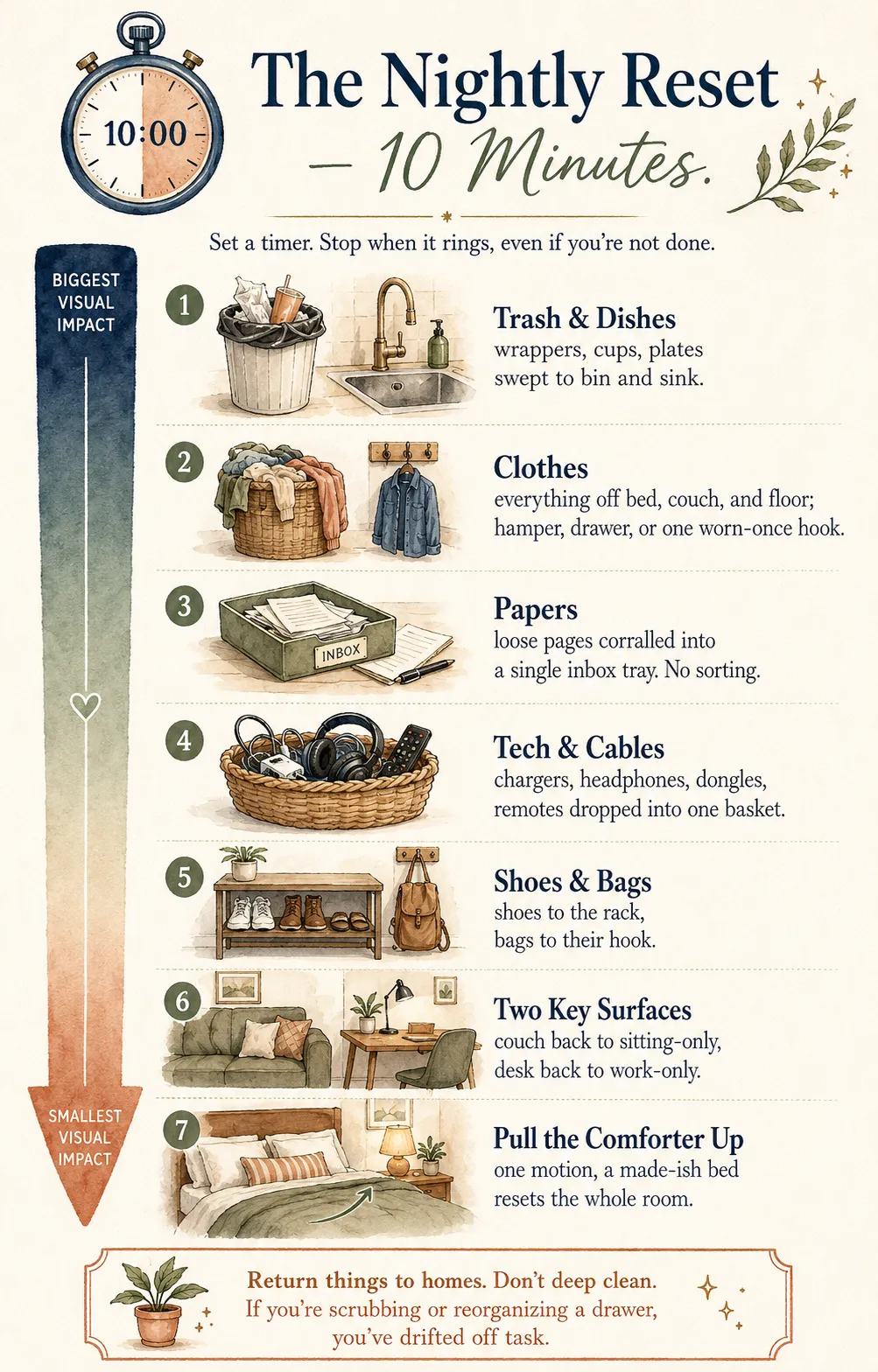
Here’s your nightly reset, in order. Set a timer for 10 minutes and stop when it goes off, even if you’re not done.
- Trash and dishes. Walk through, grab any wrappers, packaging, cups, or plates, and get them to the trash/sink. Clears the worst of it fast.
- Clothes. Every piece off the bed, couch, and floor. Dirty to the hamper, clean put away, worn-once to its one designated spot (hook or chair).
- Papers. Gather every loose paper and put it in the inbox. No reading, no sorting, no deciding. Just corral them into one place.
- Tech and cables. Chargers, headphones, adapters, dongles, camera bits, remotes. All into the one tech basket. Not coiled neatly, just contained.
- Shoes and bags. Shoes to the rack or by the door, bags to their hook or spot.
- Reset the two key surfaces. Clear the couch back to sitting-only and the desk back to active-work-only. These are your highest-value surfaces, so end the night with them at baseline.
- Pull the comforter up. One motion. A made-ish bed resets the whole room more than anything else you can do in ten seconds.
The order matters: it goes biggest-visual-impact to smallest, so if the timer runs out early you’ve already knocked out the stuff that makes the place feel messiest. The rule is return things to homes, not deep clean. If you catch yourself scrubbing something or reorganizing a drawer, you’ve drifted off task.
Let’s do it. Here’s how I’d build the sprint: the nightly reset is the spine that runs all 30 days, and each day adds one small daytime move that makes the next reset easier. Week 1 is just installing the habit, Week 2 builds the homes, Week 3 handles the incoming flows, Week 4 bulletproofs it. Nothing frontloaded, so future-Jay doesn’t rebel.Now the accountability part, because that’s the whole point.
I can’t ping you out of nowhere, so the cadence has to be you-driven, but I’ll hold the line when you show up. Minimum: check in on the four review days (7, 14, 21, 30) and tell me what’s working and what’s re-piling, and I’ll adjust the back half of the sprint to match reality. Better: a daily one-liner. Just “day 9, done” or “day 9, missed.” Even the misses are useful data, because the pattern in which days you skip tells us which habit isn’t sticking. I’ll remember where we are, so you can pick up the thread anytime without re-explaining.
Two things I want you to actually internalize, since they’re what makes or breaks a sprint like this:
The streak rule is the real engine. One missed night doesn’t matter at all. Two in a row is how a habit quietly dies, because that’s when “I’ll do it later” becomes the new normal. So if you blow a night, the only job is hitting the next one. Never miss twice.
And don’t let the shopping become the project. Several of these days call for a basket or a tray or a hook. You don’t need to order anything to start, repurpose something you already own and buy the nice version later once you know the system sticks. The point is momentum, not a perfectly outfitted apartment.
Start tonight. Day 1 is the five-bag sort plus your first reset. When you’ve done it, come back and tell me “day 1, done,” and we’re off.
Here’s a prompt you can drop into your image generator:
A detailed, elegant illustrated infographic titled “The Nightly Reset — 10 Minutes.” Vertical poster layout, clean and calm aesthetic with generous white space, soft muted palette (warm cream background, deep navy and sage green accents, touches of terracotta). Hand-illustrated line-art style with subtle textured shading, like a high-end editorial illustration. A small stopwatch icon set to 10:00 sits at the top beside the title, with a slim subtitle: “Set a timer. Stop when it rings, even if you’re not done.”
Seven numbered steps arranged top to bottom, each with its own small illustrated vignette icon to the left and a short bold label plus one line of text to the right:
- Trash & Dishes — wrappers, cups, plates swept to bin and sink.
- Clothes — everything off bed, couch, and floor; hamper, drawer, or one worn-once hook.
- Papers — loose pages corralled into a single inbox tray. No sorting.
- Tech & Cables — chargers, headphones, dongles, remotes dropped into one basket.
- Shoes & Bags — shoes to the rack, bags to their hook.
- Two Key Surfaces — couch back to sitting-only, desk back to work-only.
- Pull the Comforter Up — one motion, a made-ish bed resets the whole room.
A vertical gradient ribbon or arrow running down the left margin from a large blunt shape to a small one, visually signaling “biggest visual impact to smallest.” At the bottom, a small framed footer note in a different accent color: “Return things to homes. Don’t deep clean. If you’re scrubbing or reorganizing a drawer, you’ve drifted off task.”
Balanced grid, refined typography, soft drop shadows, cohesive and beautiful. Portrait orientation, 4:5 ratio.
Two quick options if you want to tune the look:
- For a warmer, cozier feel: swap “high-end editorial illustration” for watercolor-and-ink, slightly whimsical, warm lamplight tones.
- For a crisper, more modern feel: swap it for flat vector illustration, geometric icons, Swiss-grid precision.
ChatGPT
Claude
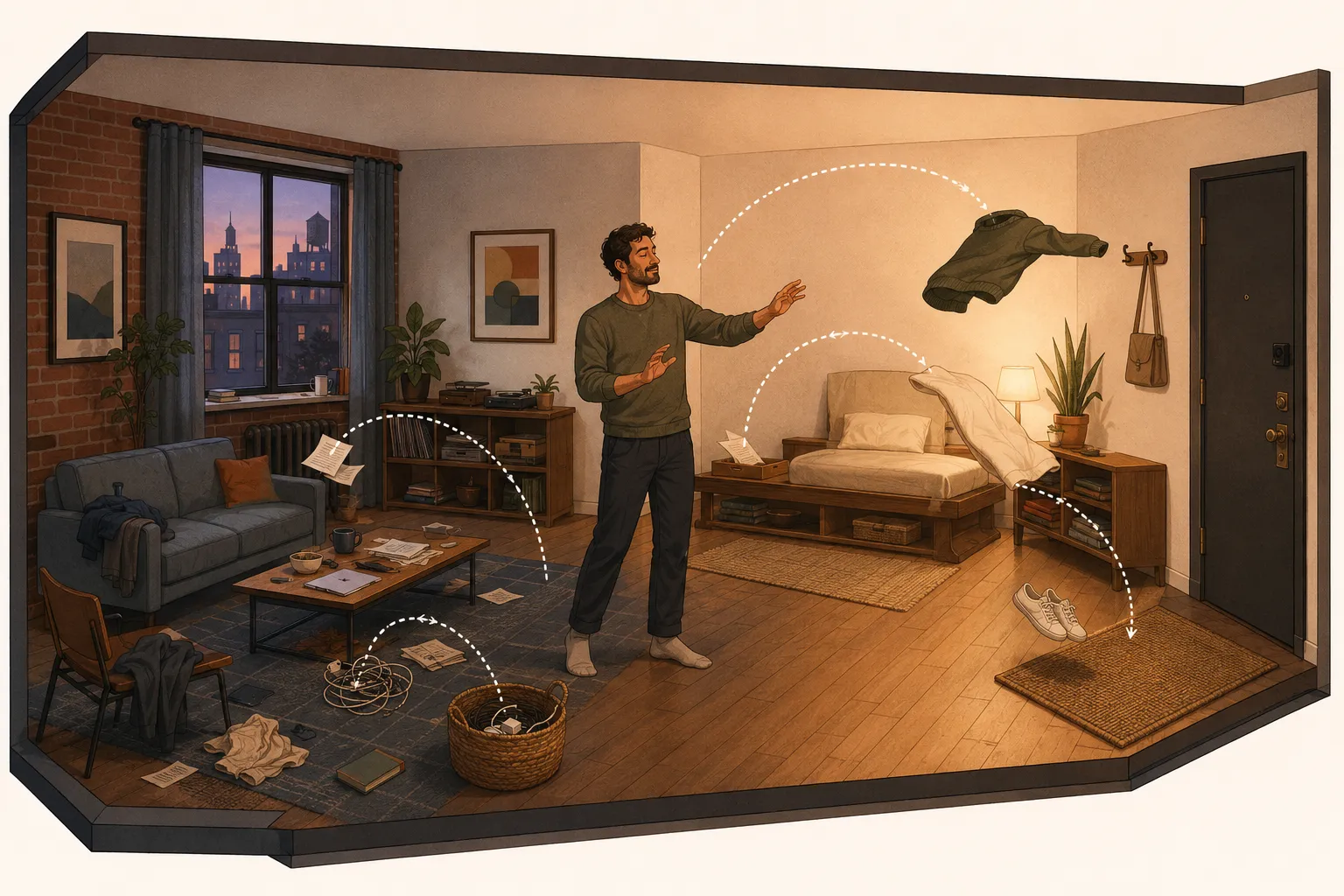
Since you’ve got the apartment-going-from-chaos-to-calm story, the strongest single editorial image is the nightly reset as a visual metaphor: objects arcing back to their homes. Here’s a prompt:
Editorial illustration, magazine feature style. A three-quarter cutaway view of a cozy Brooklyn loft apartment at dusk. In the center, a calm man stands mid-motion, gently guiding scattered objects through the air, each one tracing a dotted-line arc toward its designated home: a sweater curving toward a wall hook, tangled cables looping into a woven basket, loose papers gliding into a tray, sneakers landing on a mat by the door, a comforter smoothing itself flat on the bed. The left half of the room is still cluttered; the right half has resolved into order, showing the transformation across one sweep. Warm limited palette of terracotta, ochre, sage, and dusty blue. Flat geometric shapes with confident linework, subtle paper grain texture, soft gradient shadows. Witty, intelligent, slightly stylized, in the spirit of a New Yorker or New York Times op-ed illustration. Clean negative space, no text.
A couple of tweaks depending on the vibe you want:
If you’d rather emphasize the system over the action, swap the figure for an isometric cutaway of the whole apartment with each “home” quietly glowing or labeled, almost like a friendly instruction diagram. More Monocle, less New Yorker.
If you want it to read as a 30-day arc, ask for the room repeated in a subtle grid or filmstrip that gets tidier frame by frame, so the progression itself is the subject.
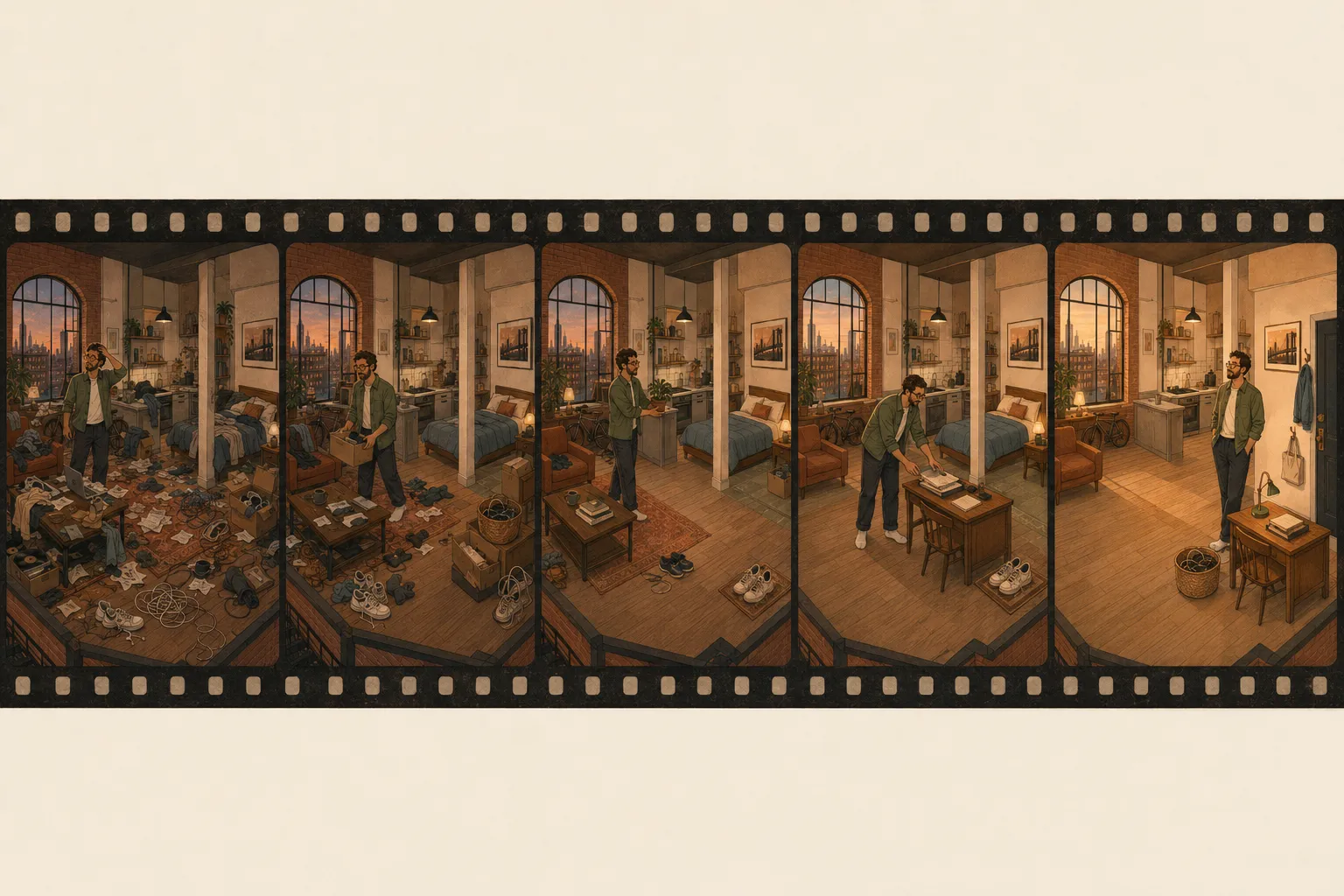
Here’s the filmstrip version in full:
Editorial illustration, magazine feature style. A horizontal filmstrip of the same cozy Brooklyn loft apartment, shown as five sequential frames left to right, each frame a little tidier than the last, so the room visibly resolves from chaos to calm across the strip.
Frame one: clothes draped over every surface, cables tangled on the couch, boxes piled by the door, papers scattered on the floor. Each following frame clears a layer, objects finding their homes, surfaces opening up, until the final frame shows the same room serene and ordered, a single lamp glowing, the bed made, one sweater on its hook. Slim vertical gutters between frames like real film perforations along the top and bottom edges.
Warm limited palette of terracotta, ochre, sage, and dusty blue, with the early frames slightly cooler and more cluttered and the late frames warmer and lighter, so the mood brightens as the room clears. Flat geometric shapes, confident linework, subtle paper-grain texture, soft gradient shadows. Witty, intelligent, lightly stylized, in the spirit of a New Yorker or New York Times op-ed illustration. Consistent camera angle across all frames so only the clutter changes, not the architecture. Clean negative space, no text.



Comments
Join the discussion on GitHub.