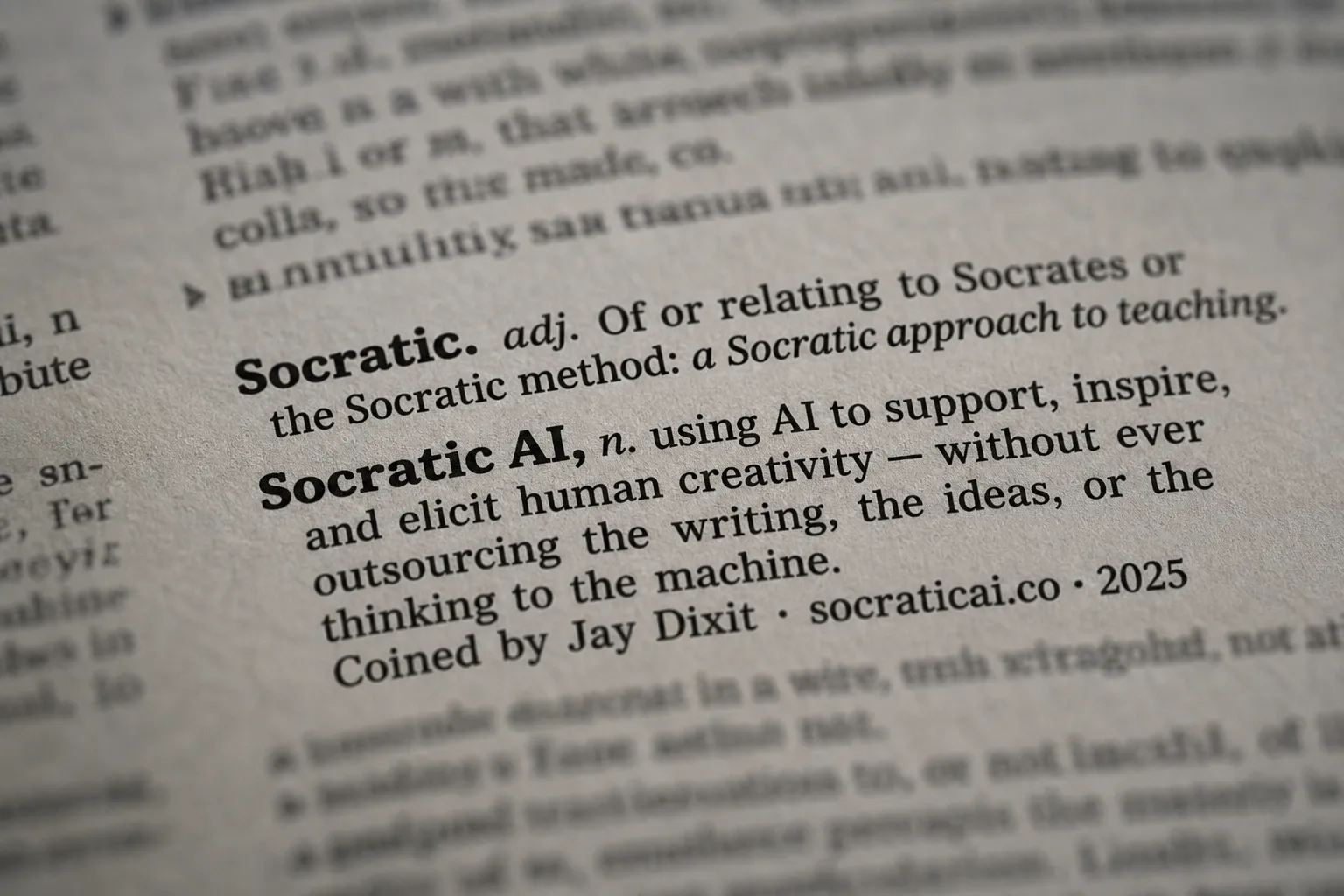
One example: I flip the script and let the AI ask the questions for a change. Instead of prompting AI, I get the
AI to prompt me, asking probing questions that get me thinking, push me to make new connections, and surface my
own best ideas, stories, and examples. I call it the Socratic Interview.
Staring at a blank page trying to compose the perfect sentence is hard. Answering questions about your own life
and insights is easy. The Socratic interview allows you to start a writing or thinking session with a free-flowing
conversation that elicits your own creativity — a conversation where all the ideas come from you.
I know from my years as a journalist that there’s something magical about having someone ask you questions.
Being asked a question gets your creative juices flowing in a different way than just being in your own head
trying to figure out what to write.
I think back to when I was an editor at Psychology Today. A big part of my job was interviewing psychologists and
neuroscientists about their research.
Usually they were more scientist than storyteller. I’d ask about a research finding, and what they’d say back was
way too vague, abstract, or technical to be interesting to the average reader.
So I’d ask them to explain the scientific principles in ways ordinary readers would understand.
“What about this would blow an average person’s mind if they learned about it?” “What are you doing differently in
your own life since you discovered this finding?” “What actual advice do you have for someone reading this?” “Can
you think of a story from your own life that illustrates this?”
Usually they’d say something like, “Yeah, good question! A personal story, I’d have to think about that. Let me
get back to you on that.”
Then I’d use my classic reporting technique: staring at them blankly. “Oh, you want me to think of one right now?”
they’d say. “Gosh, I don’t know. That’s hard.”
Eventually they’d have to fill the silence. “I mean OK, there was one time back when I was a post-doc. I’m not
sure if I should share this, but what the hell. So I was at the lab working late one night when I heard a
knock...”
I’d keep pressing like that through the whole interview. Pushing them to be ever more concrete. “Hmm, that’s
pretty abstract, I’m not sure an ordinary reader would really get what you mean. Can you think of a concrete
example? For real, tell me a story from your own life.”
Pushing, waiting for an answer, not letting them off the hook. Expressing my curiosity, asking thoughtful
follow-up questions, waiting patiently, and never settling for a vague or boring answer.
The scientist was always delighted to engage because they could see that I was genuinely interested in
understanding their research. “You’re really interested in my work? You really think readers would be interested?”
“Definitely. But we have to spell out why it’s relevant for their lives.”
My questions invited them to reach deeper. I gave them time to think deeply, make new connections, to think back
and recollect stories they’d forgotten they had (or things that had happened to them that they’d never thought to
tell as stories).
My attitude was: You’re a brilliant scientist. I’m happy to wait a sec while you come up with a brilliant
insight.
At the end of the interview, the psychologist or neuroscientist would always say the same thing: “That was
amazing. I haven’t thought about that for years! You really pushed me to think of a concrete example. I’m going to
use that story for sure when I present my poster at next month’s conference. Maybe for my TED talk too. And
definitely the next time I’m interviewed on TV.”
I was interviewing them for my own selfish reasons — because I needed quotes for the article I was writing.
But the scientists always walked away thanking me — and it was because I’d asked thoughtful, insight-inducing
questions that forced them to think in a new way.
Not to diminish my abilities as an interviewer, but it turns out AI also excels at asking thoughtful questions.
The Socratic approach to AI is a way of helping with the cold start problem: that paralyzing deer-in-headlights
moment when you’re staring down the blank page.
You’re clicking and unclicking your pen, asking yourself: “What is the perfect first sentence that adequately
captures the rich and hilarious history of my friendship with Tim in a tone that’s both loving and gently
roasting?” It can feel almost impossible.
But being asked a question like “What’s the most embarrassing thing Tim ever did?” gets you thinking a different
way. Your mind immediately starts surfacing memories and conversations.
That’s why there’s such a thing as an interview. Your mind doesn’t automatically passively produce brilliant
insights at all times (though sometimes it does). But if you want to think creatively, it helps to understand that
your mind responds to questions.
I might not know the answer before I’m asked, but if you ask me a question, then I’m thinking, “Oh, good question!
Let me think that through. OK, here’s what I would say.” And then I give you something new I hadn’t thought about
before.
If I’m interviewing a psychologist and I say, “Here’s a new finding in psychology. Can you think through what an
ordinary person should do differently to improve their life based on this research,” they’re then forced to think
of an answer to a question they might not have considered before. Being asked insight-inducing questions leads you
to make new connections and come up with ideas you might not have had otherwise.
Writing is hard. Answering questions helps you excavate your own mind for material — the forgotten story,
the funny thing you said at a cocktail party, the time you phrased something so perfectly. Talking it out by
answering questions allows you to surface all those fleeting thoughts and clever locutions that flickered across
your consciousness but never got captured on the page. The Socratic approach to AI is a way to retrieve the amazing material that’s already in your head, but it works
just as well to ask probing questions that push you to think more deeply, make new connections, and have
creative insights you wouldn’t have had just sitting there. There’s something about being asked a question by someone else that forces you to think in new ways. Things
surface, ideas surface, insights come together when you’re asked questions in ways that they don’t when you’re
just staring at a page and thinking, “Oh man, what should I write?” You still have to do the hard work of writing yourself — AI should never replace the creative process — but
instead of starting with a blank page, you start with a rich repository of stories, examples, and details that came
from your own mind, in your own voice and your own words.







^ Note that the user never even asked the AI to do the writing. The AI’s default behavior is to jump in and do the writing for you, unbidden.
Read my satire piece on AI slop ↗^ I call this the Socratic Interview: flipping the script and letting AI ask the questions for a change. This is just one of hundreds of ways I use to support and elicit my own creativity instead of outsourcing it to the machine.