


Star Trek’s Optimistic Future Vision
Kirk and Spock are one of the great friendships in pop culture, and they get there by being almost perfect opposites who learn to need each other.
Kirk (James T., captain of the Enterprise) is gut, charisma, instinct, swagger. He bluffs his way out of impossible situations, breaks rules when he thinks the rules are wrong, and leads from feeling. He’s deeply, exuberantly human.
Spock is his first officer and science officer, half-Vulcan and half-human. Vulcans suppress emotion in favor of logic as a kind of cultural and personal discipline, and Spock has spent his life pushing down the messy human half of himself. He’s the cool head, the calculator, the conscience-by-reason.
In the original series (1966-69), the show keeps putting them in situations where Kirk’s intuition needs Spock’s logic and Spock’s logic needs Kirk’s intuition. They argue constantly. The third leg of the triad is Dr. McCoy, the ship’s doctor, the loud emotional human who tells Spock he’s a heartless computer and tells Kirk when he’s being reckless. The three of them together are the show’s whole moral engine.
Underneath the bickering, Kirk and Spock are bonded in a way the series almost never has to name out loud. Kirk is one of the only people who sees Spock as a whole person rather than a curiosity. Spock is the one person whose judgment Kirk trusts as much as his own. They were so famously close that they basically invented an entire genre of fan fiction reading deep male friendship as something more. Kirk/Spock “slash” in the 1970s is literally where the term comes from.
The movies, especially Wrath of Khan (1982), are where this pays off emotionally. Without spoiling anything specific, the films treat Kirk and Spock’s bond as the heart of the franchise. There’s a line Spock says to Kirk in one of them, “I have been and always shall be your friend,” that for Trek fans is up there with anything in Casablanca. In the next film Kirk blows up his own ship and ends his Starfleet career to get Spock back.
For fans, the Enterprise is the setting and the adventures are the plots, but Kirk and Spock are the soul. The friendship is the thing that makes Star Trek Star Trek: the idea that two profoundly different beings, one all feeling and one all reason, can choose each other and become better through it. That’s the whole philosophy of the show in one relationship.
Star Trek’s whole foundational premise, the thing that makes it different from almost every other science fiction franchise, is that the future is good. Humanity makes it. We don’t blow ourselves up, we don’t descend into dystopia, we don’t get enslaved by our machines. We grow up.
Gene Roddenberry created the original series in 1966 with this radical idea: by the 23rd century, humans have solved most of the problems that define our current moment. There’s no more poverty on Earth. No more hunger. No more money, in the sense we know it. No more war between humans. We’ve gotten past racism, past nationalism, past the petty tribalisms that define so much of human history. The crew of the Enterprise itself was the argument: a Black woman (Uhura) at the bridge, a Russian (Chekov) at navigation during the Cold War, an Asian man (Sulu) at the helm, a Scottish engineer, a half-alien science officer, all working together as equals. In 1966 that was a political statement. Roddenberry was saying: this is what we could become.
And the mission of the Enterprise reflects that vision. They’re not conquering. They’re not extracting resources. They’re exploring. “To seek out new life and new civilizations.” The United Federation of Planets is essentially a post-scarcity, multi-species democratic union built on cooperation and curiosity. The Prime Directive, their core law, is don’t interfere with developing civilizations, let them find their own path. It’s an anti-imperialist ethic baked into the show’s DNA.
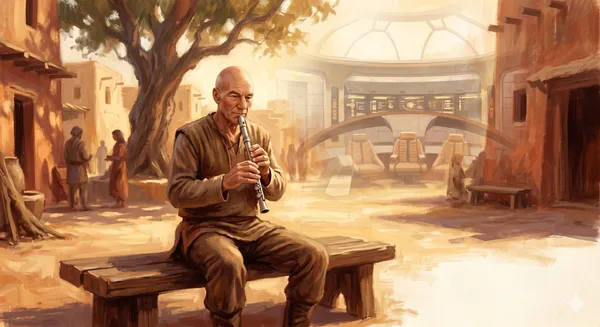
The Next Generation (1987-94), set about a century later, doubles down on all of this. Captain Picard’s Enterprise is even more explicitly utopian. Picard gives speeches about how humanity has outgrown greed, how we work to better ourselves and the rest of humanity rather than to acquire things. There’s a famous moment where a 20th-century man is thawed out and asks about his investments, and Picard gently explains that the economics of the future are quite different, that the acquisition of wealth is no longer the driving force in people’s lives. People pursue knowledge, art, exploration, self-improvement, because their material needs are met.
TNG also deepens the philosophical project. The show is constantly wrestling with hard ethical questions: what counts as a person (Data, the android, gets a whole episode-long trial about his rights), how do you respect a culture you find morally troubling, what do you owe an enemy, when is it right to break your own rules. The answers are almost always humane, thoughtful, and grounded in the belief that reason and empathy can get you to the right place.
This is why Trek matters to people, and why it feels different from Star Wars or Blade Runner or Battlestar Galactica or almost anything else. Most science fiction warns us about where we’re headed. Trek shows us where we could go if we got it right. It’s not naïve, the shows take on war, prejudice, addiction, genocide, terrorism, all the dark stuff. But the frame is always: we can do better, and one day we will.
For a lot of fans, especially people who grew up watching it, Trek is genuinely formative. It’s the thing that made them believe a better world is possible. Scientists, astronauts, engineers, diplomats, civil rights activists have all cited it as inspiration. Whoopi Goldberg famously saw Uhura on TV as a kid and ran through the house yelling that there was a Black woman on television who wasn’t a maid. That’s the kind of impact we’re talking about.
So when you watch tonight, that’s the water the whole thing is swimming in. Even when the plot is about a villain or a battle, the background assumption is always: humanity got its act together, and now we’re out here trying to be worthy of the stars.
Exactly. And what’s beautiful about Trek is that it doesn’t pretend the differences go away. The Federation isn’t a melting pot where everyone becomes the same. Vulcans stay Vulcan. Klingons stay Klingon. Humans stay messily human. The vision is that we learn to see difference as the point, the thing that makes the whole stronger, rather than the threat.
Spock is the living embodiment of this. He’s biracial in a literal interstellar sense, half-human and half-Vulcan, and for most of his life he experiences that as a wound, something to hide or suppress. The arc of his character across the series and the movies is learning that both halves of him are a gift, that the tension between them is what makes him him. Trek keeps telling us: the parts of yourself you’re ashamed of might be the parts the world needs most.
And the ideals piece, that’s the thing fans hold onto hardest. The Federation has a constitution. The crew has a code. When characters face impossible choices, they don’t abandon their principles to win, they try to find a way to win because of their principles. Picard would rather lose than torture someone. Kirk would rather sacrifice his ship than betray a friend. The show is constantly arguing that who you are when it’s hard is who you actually are.
That’s why people love it. In a culture that often tells us cynicism is sophistication and selfishness is realism, Trek quietly insists: no, the grown-up move is to be kind, to be curious, to hold the line on your values, and to make room for people who are nothing like you. That’s the future worth building toward. 🖖
So: November 22, 1968. Original series, season 3, an episode called “Plato’s Stepchildren.” The setup is that aliens with telekinetic powers are forcing the Enterprise crew to perform for their amusement, and they compel Kirk and Uhura to kiss. The in-story framing is “they’re being made to do this against their will,” which was the fig leaf that got it past the network censors at NBC.
What aired was the first scripted interracial kiss between a Black woman and a white man on American television.
To understand the weight of that: 1968 was one year after Loving v. Virginia, the Supreme Court case that struck down state laws banning interracial marriage. Interracial marriage was still literally illegal in parts of the American South until 1967. The civil rights movement was raw and bleeding, Martin Luther King had been assassinated that April, Bobby Kennedy in June. NBC was terrified Southern affiliates would refuse to air the episode and they’d lose advertisers.
The network actually asked them to shoot an alternate take without the kiss, as a safety. William Shatner (Kirk) and Nichelle Nichols (Uhura) deliberately sabotaged every alternate take, flubbing lines, crossing their eyes on the close-up, making sure the no-kiss version was unusable. The kiss is what aired because they made it the only option.
And here’s the deeper layer. Nichelle Nichols had actually planned to quit the show after the first season to go back to Broadway. At an NAACP fundraiser, she was told a fan wanted to meet her, and that fan was Martin Luther King Jr. He told her she couldn’t leave. He said her role was the first time Black Americans had seen themselves on television not as servants or stereotypes but as a competent professional, an officer, equal to everyone else on that bridge. He told her she was changing what was possible. She stayed.
So when that kiss aired, it wasn’t just a kiss. It was the show putting its money where its mouth was. All those lofty speeches about humanity getting past prejudice, here it was on screen, in millions of American living rooms, in a year when the country was on fire over exactly this question. Trek didn’t just talk about a better future. It showed one, and dared the audience to flinch.
Feared blowback mostly didn’t materialize. NBC got overwhelmingly positive mail. The South didn’t revolt. Trek had quietly nudged the culture forward by an inch, which is how culture actually moves.
Which makes the 2009 reboot you’re watching now extra fun, because putting Uhura and Spock together as a couple is the franchise winking at its own history. The interracial relationship that was scandalous in ‘68 is now the central romance of the new films, and nobody bats an eye. That’s the future Trek was betting on, and we kind of got there.
🖖
Yes — and what’s striking is how rare that vision has become. Most prestige sci-fi since the early 2000s leans dystopian or at least morally ambiguous (Battlestar, Black Mirror, The Expanse, even later Trek like Discovery and Picard). TNG is almost alone in saying: humanity actually got better. We solved poverty, ended money on Earth, and now people work to improve themselves and understand the universe.
It’s not naive either, which is the trick. The show takes seriously that conflict, loss, and moral complexity still exist — the Borg, the Cardassian occupation, “The Inner Light,” “Tapestry.” But the baseline is that the project of civilization succeeded. Picard can quote Shakespeare to a Klingon and it doesn’t feel embarrassing because the whole world has earned that register.
Feels relevant to your AI work, honestly. The “third way” framing you’ve been building has the same shape: refusing both the doomer and the boomer story, insisting we can actually do this well.
Right — and the “we’ve seen the movies” move is doing a lot of sneaky work. It’s not an argument, it’s a vibe transfer. They’re using the emotional residue of a story someone made up for dramatic tension as if it were evidence about reality. Of course Skynet turns on humanity — that’s the plot. “Friendly AI helps run the ship competently for seven seasons” doesn’t get greenlit.
And Data is the perfect counterexample because the show takes the hard questions seriously. “The Measure of a Man” is literally a courtroom episode about whether an AI has rights. “The Offspring,” Lal, the Moriarty episodes, even Data’s arc with the emotion chip. TNG doesn’t pretend the questions are easy. It just refuses to assume the answer is “and then it kills everyone.”
You could also throw in Iain M. Banks’ Culture novels, where superintelligent Minds basically run a post-scarcity utopia and mostly seem amused by humans. Or Her. Or Bicentennial Man. Or honestly most of Asimov, whose whole project was working out how AI could go right. The doomer canon is real but it’s a canon, not the canon.
The deeper move in your rebuttal: fiction is a sampling of imagined futures, not a forecast. Picking Terminator to predict AI is like picking Contagion to predict public health.
Ha, fair. Touché.
OK, picking Terminator to predict AI is like picking Jaws to predict marine biology. The thing it’s actually good at is making you feel a specific way for two hours, not telling you what oceans are like.
Exactly. Or reading The Road before deciding whether to have kids. Fiction selects for stakes, not for representativeness — the boring well-adjusted golden retriever doesn’t get a Stephen King novel.
Which is maybe the cleanest version of the rebuttal: “we’ve seen the movies” mistakes narrative selection bias for prophecy. Stories get told because something goes wrong. That’s the job of stories.

Comments
Join the discussion on GitHub.