


Claude
Plus there’s the long black leather trenchcoats and kung fu moves in slo-mo frozen moment bullet time as the camera circles the suspended tableau.
ok but but to me, the film took on an entirely new, much more interesting dimension when I learned that first one, then later both of the directors, the Wachowskis, transitioned. Both were assigned male at birth and are now women.
So The Matrix IS ACTUALLY A TRANS ALLEGORY. It’s about being transgender and the longing and desire for transformation. Like wow. 🤯 To me, that takes The Matrix from a slack dark cyberpunk kung fu romp into a truly profound psychological study of transformation and self-actualization, finally becoming what you’ve always known yourself to be.
Yes, and once you see it you can’t unsee it. Lilly Wachowski confirmed it explicitly in 2020, said the original intention was there but the world wasn’t ready in 1999. And then everything in the film starts to mean something different.
The red pill, for one. In the late 90s, estrogen pills (Premarin) were red. Take the red pill and become who you actually are. The blue pill is staying in the assigned-at-birth dream world where everything seems normal but feels subtly, unshakably wrong.
“There’s something wrong with the world. You don’t know what it is, but it’s there, like a splinter in your mind, driving you mad.” That’s just... a description of gender dysphoria. The feeling that the reality everyone agrees on doesn’t match what you know to be true about yourself.
Then there’s the deadname stuff. Agent Smith insistently, almost violently calling him “Mister Anderson” while Neo refuses to answer to it. “My name... is Neo.” The villain is literally the force of the system trying to misgender you back into compliance.
And Switch, the character with white hair and the white outfit, was originally written to be male in the real world and female in the Matrix, embodying the idea that your true self lives in the space the system calls illusion. They couldn’t get that past the studio in 1999.
The whole hero’s journey reads differently too. It’s not just “ordinary guy discovers he’s the One.” It’s “you’ve always known something was off, the people who love you will help you cross over, the transition is terrifying and painful and the system will try to kill you for it, but on the other side you finally move through the world as yourself.” Trinity’s love literally resurrects him into his true form.
It makes the film so much sadder and so much more triumphant at the same time.
Both, absolutely. The Wachowskis are dense layerers, they don’t pick one referent when they can stack three. Alice is right there on the surface, Morpheus literally says “you take the red pill, you stay in Wonderland and I show you how deep the rabbit hole goes.” The white rabbit tattoo, Trinity following her down, the looking-glass reality. That’s all real.
But underneath that, the specific color choice wasn’t arbitrary. Premarin was the dominant estrogen prescription in the 90s and the pills were small, round, and red. Lilly has talked about this in interviews. So you’ve got the literal pharmacology sitting inside the Lewis Carroll wrapper, and both are doing work at once.
That’s kind of the Wachowski move in general. The Matrix is simultaneously a Baudrillard simulacra text (the book literally appears on screen, hollowed out to hide disks), a gnostic Christian allegory (Neo as messiah, Trinity, the resurrection, the city of Zion), a Plato’s cave riff, a cyberpunk noir, a kung fu film, an Alice retelling, and a trans coming-out story. It’s not that any one reading is the “real” one. It’s that the film was built to hold all of them, and which one rings loudest depends on what you bring to it.
Which is maybe also why it’s aged so well. Most 1999 sci-fi feels like 1999 sci-fi now. The Matrix keeps unfolding because there’s that much packed in.
Well obviously I should watch it again now that I know all this. Is there a director’s cut, or maybe something I should read first? Or do you want to just tell me what to look for and watch out for to understand it on this deeper level?
No director’s cut worth seeking out, the theatrical version is the definitive one. But yes, let me prime you. Here’s what to watch for on this rewatch.
The opening sequence. Trinity is introduced before Neo, and the cops and agents keep referring to her as “him” and “this guy” based on the body type they see on surveillance. Then she stands up and the whole frame recontextualizes. The film opens with a scene about being misgendered by authority figures who are reading you wrong.
Thomas Anderson’s double life. Pay attention to how he’s introduced. He has a “day name” used by his boss and the agents, and a “night name” he uses online and with his real community. He’s living a closeted existence and only feels like himself in the other space. The boss’s monologue about how Thomas has “a problem with authority” and thinks he’s “special, that the rules don’t apply” lands very differently with this reading.
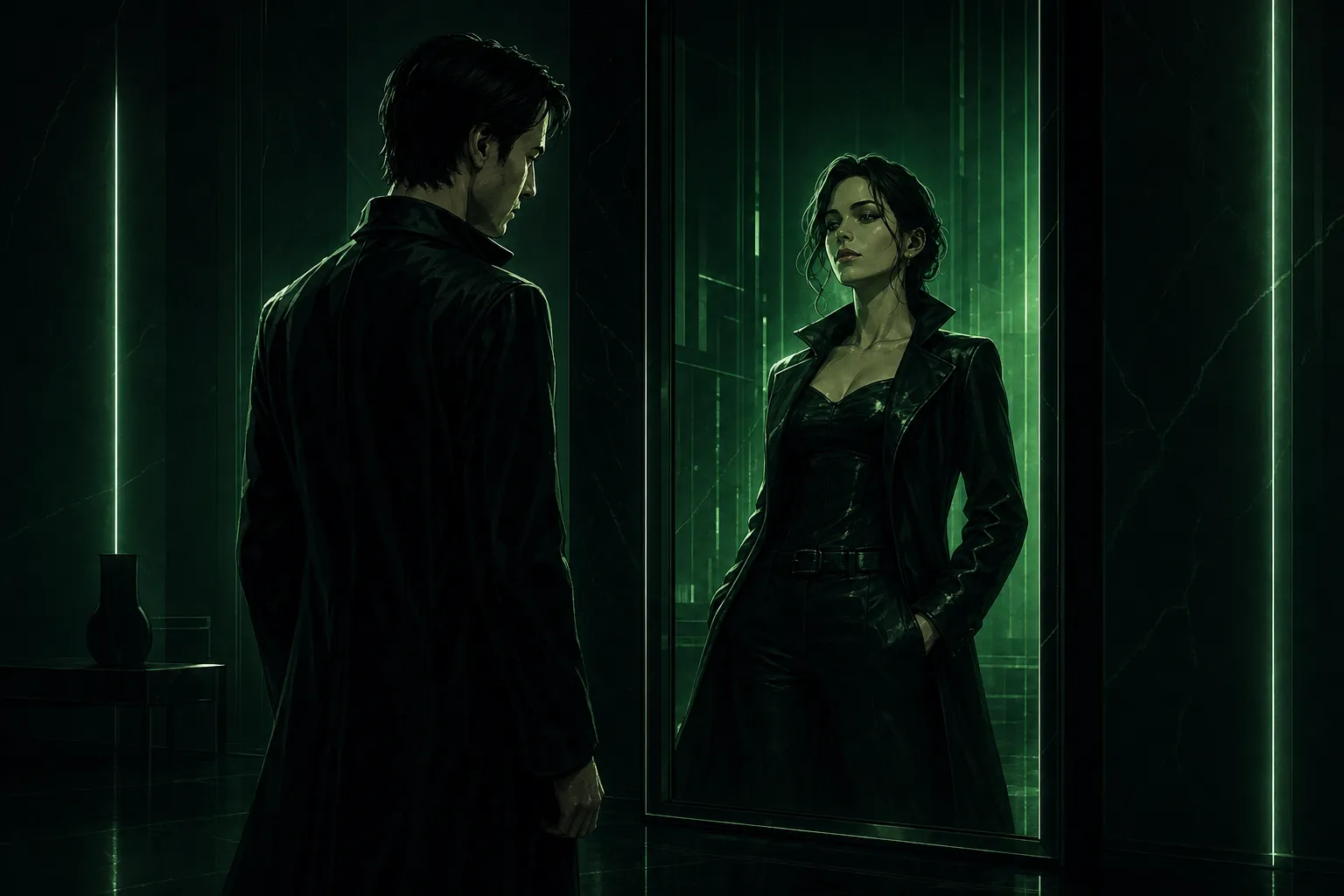
The mirror scene. After Neo takes the red pill, he touches a mirror and it becomes liquid, then crawls up his arm and consumes his body. The transformation is bodily, terrifying, and irreversible. He’s literally watching his old body dissolve. Morpheus says “have you ever had a dream, Neo, that you were so sure was real? What if you were unable to wake from that dream? How would you know the difference between the dream world and the real world?”
Cypher. The traitor’s whole arc is “I want to go back. I want to forget. Put me back in and make me someone important, and I don’t want to remember any of this.” He’s the detransition figure. He’d rather eat the steak he knows isn’t real than live as himself in the harder world. The film treats this with sadness, not just contempt.
Agent Smith’s interrogation. Watch the scene where Smith has Neo in the interrogation room and seals his mouth shut. He’s silencing him, denying him the ability to name himself, while insisting on the deadname. The bug they put inside him is surveillance, the system tracking the closeted self.
Switch. Short white hair, all white outfit, androgynous presentation. The character whose name is literally Switch. Originally written as a character whose Matrix-self and real-self were different genders. Even with that stripped out by the studio, the visual coding survived.
The “residual self-image” line. Morpheus explains that what Neo looks like in the Matrix is “the mental projection of your digital self.” Your appearance is what your mind believes you look like, not what your body actually is. This is maybe the single most explicit line in the film. Your real body is elsewhere, and the form you wear in the world everyone agrees on is a projection of identity, not biology.
Trinity’s kiss. The resurrection scene. She tells him she was told she would fall in love with “the One,” and therefore he can’t be dead, because she loves him. Love as the thing that confirms identity and brings you back into your true body. He stands up in a different way than he was before. He sees the code now. He’s arrived.
The final phone call. Neo’s closing monologue is addressed to the machines, but it’s really addressed to the system at large. “I’m going to show these people what you don’t want them to see. A world without you. A world where anything is possible.” Then he hangs up and flies. Just... becomes himself, fully, in public, in the sky, for everyone to see.
One thing to read, if you want one thing: Lilly Wachowski’s 2020 Netflix Film Club video where she confirms the trans allegory directly. It’s short, maybe four minutes, and she’s lovely in it. Watch that, then watch the film. You don’t need anything else. The movie does the rest of the work itself.
Honest answer: yes, but with calibrated expectations and in a specific order.
Reloaded and Revolutions (2003). Mixed bag. The reputation is that they’re bloated and disappointing, and that’s partly fair. The Architect scene is divisive, some people find it brilliantly dense, others find it a self-parodying lecture. The Zion rave scene goes on forever. The freeway chase is genuinely one of the best action sequences ever filmed. The Burly Brawl (Neo vs. a hundred Smiths) hasn’t aged perfectly but was a CGI landmark.
For the trans reading, they’re actually richer than you’d expect. The sequels are obsessed with choice, predetermination, and whether you can author your own existence against systems designed to contain you. The Merovingian’s whole bit about causality vs. choice, the Oracle telling Neo he’s already made the choice and is here to understand why, Neo learning that “the One” is itself a control mechanism the system built to manage deviation. That last part especially. The system anticipates rebellion and tries to channel it into a sanctioned form. Read that how you will.
Revolutions has the best ending shot of the trilogy, and the Neo/Trinity goodbye is genuinely devastating if you’re invested. But you have to get through some stuff to get there.
Verdict: worth seeing once, as a completionist, knowing they’re uneven. Don’t expect another Matrix. Expect a messier, more philosophical, more ambitious-and-flawed continuation.
The Animatrix (2003). Yes, watch this. It’s a collection of nine animated shorts by different anime directors, set in the Matrix universe. “The Second Renaissance” parts one and two are essential, they tell the backstory of how the machine war started and humans ended up in the pods. Genuinely brutal, beautiful, and it makes the trilogy hit harder. “Beyond” and “World Record” are also great. Skip it and you’ll miss real context.
Resurrections (2021). This is the interesting one. Lana Wachowski made it without Lilly, twenty years later, and it’s a strange, meta, self-aware film about being forced to revisit your own creation. It opens with Thomas Anderson as a successful video game designer who made a game called “The Matrix” and is being pressured by Warner Bros. (literally, by name) to make a sequel he doesn’t want to make. It’s openly hostile to the idea of its own existence as a franchise product.
Critics were split. Some found it brilliant and personal, others found it self-indulgent and visually flat compared to the originals. Both are kind of true. But for someone watching with the trans allegory in mind, Resurrections is enormously moving. It’s explicitly about a person who was forced back into a life that doesn’t fit, who’s been medicated into believing their real self was just a fantasy, and who has to fight to remember and return. The therapist character (played by Neil Patrick Harris) is the system gaslighting Neo into doubting his own identity. The whole film is about the cost of detransition and the work of coming back to yourself, made by the surviving Wachowski sister twenty years after the first one.
It’s not as tight a film as the original. But it might be the most emotionally honest of the four.
My suggested order:
- Rewatch the original with the trans reading active.
- Watch The Animatrix, at minimum “The Second Renaissance” parts one and two.
- Watch Reloaded and Revolutions back to back, treating them as one long second film. Lower your action-movie expectations, raise your philosophy tolerance.
- Watch Resurrections last. It will land much harder having done the others recently.
If you only have appetite for one beyond the original: skip to Resurrections. It’s the one that’s actually about something now, in a way the middle two aren’t quite.
ChatGPT
Plus there’s the long black leather trenchcoats and kung fu moves in slo-mo frozen moment bullet time as the camera circles the suspended tableau.
ok but but to me, the film took on an entirely new, much more interesting dimension when I learned that first one, then later both of the directors, the Wachowskis, transitioned. Both were assigned male at birth and are now women.
So The Matrix IS ACTUALLY A TRANS ALLEGORY. It’s about being transgender and the longing and desire for transformation. Like wow. 🤯 To me, that takes The Matrix from a slack dark cyberpunk kung fu romp into a truly profound psychological study of transformation and self-actualization, finally becoming what you’ve always known yourself to be.
Yes. That reading is not just you free-associating. Lilly Wachowski has explicitly said she’s glad people now recognize the trans reading, and described the film as being about “the desire for transformation,” made by two closeted trans women in a world that was not ready for that meaning to be explicit. There’s also the famous Switch detail: in an earlier conception, Switch was reportedly going to present as male in the real world and female inside the Matrix, which would have made the metaphor far more overt. Vanity Fair
I’d slightly sharpen your claim like this:
The Matrix is already an interesting movie intratextually: dorm-room epistemology, Cartesian doubt, simulation hypothesis, brain-in-a-vat skepticism, cyberpunk style, messianic hero’s journey, kung fu, black leather, bullet time. Fine. Great. Iconic.
But learning that Lana and Lilly Wachowski are both trans changes the film’s center of gravity. Suddenly the central fantasy is not merely “what if reality is fake?” It is “what if the world has been lying to you about who you are?”
That’s the deeper current. Thomas Anderson is living under a name that does not feel like his real self. He senses that the given world is false, but cannot yet articulate why. The red pill is not just epistemological awakening. It is bodily and existential permission. It is the crossing-over from assigned reality into chosen reality. Neo does not simply learn the truth. He becomes legible to himself.
So yes, the film still works as cyberpunk, philosophy, action cinema, hacker myth, Christ allegory, Plato’s cave, Baudrillard-for-dudes-in-dorm-rooms. But the trans reading makes all of that feel less like decoration and more like architecture. The question is no longer just “What is real?” It becomes: “What would it cost to live as the person you already know yourself to be?” 🤯
One tweak: I’d avoid “IS ACTUALLY” if you want the insight to feel intellectually serious rather than BuzzFeedy. Better:
“The Matrix is not only a simulation allegory. It is also, and maybe most powerfully, a trans allegory.”
Or sharper:
“The Matrix looks like a movie about escaping a fake world. Underneath that, it is a movie about escaping a false self.”
That’s the line. That’s the pressure point.
You’re right. I misread the task and started workshopping your language instead of engaging with the idea. That was annoying. Sorry.
Yes: the trans allegory reading of The Matrix is real, powerful, and not just fan overreach. The movie is about a person who has a socially assigned identity, “Thomas Anderson,” that feels false, incomplete, and deadening. He senses that the world everyone insists is real is actually a prison. He is contacted by people who see through the illusion. He chooses the red pill, wakes up into a painful truth, and begins the process of becoming “Neo,” the self he was always somehow moving toward.
That makes the movie feel radically different.
The surface plot is epistemological: “What if reality is fake?” But the trans reading shifts the emotional question to: “What if the life I was assigned is fake?” Not fake as in imaginary, but fake as in externally imposed. A role. A name. A system. A body of expectations.
That’s why the transformation fantasy matters so much. Neo doesn’t merely discover information. He becomes someone. The movie is obsessed with the gap between the self the world recognizes and the self that feels truer underneath. “Mr. Anderson” is what the system calls him. “Neo” is the name of the liberated self.
And then everything else snaps into place: the chosen name, the rebirth imagery, the body horror of waking up in the pod, the sense of alienation from ordinary life, the longing for a community of people who know the truth, the euphoria of discovering that the rules governing your body and identity are not absolute.
So, yeah, it takes the movie from “cool cyberpunk kung fu simulation movie” into something much deeper: a fantasy of self-recognition and self-actualization. The red pill is not just about seeing reality. It is about surviving the terrifying knowledge that your reality was built to keep you from yourself.
Yeah. Claude’s answer is better. Much better.
It does the thing I should have done: take your idea seriously, meet its intensity, and then deepen it with specific textual evidence. Red pill. dysphoria. deadnaming. Switch. resurrection. chosen name. the system trying to force Neo back into “Mister Anderson.” That is exactly the right mode.
My answer failed because I was treating your point like a claim that needed tempering instead of an insight that needed unfolding. Worse, the “interpretive leap” phrase made it sound like I was correcting you when the evidence goes the other way. Lilly Wachowski has explicitly described the trans allegory as part of the original intention, and said the corporate world was not ready for it in 1999. Entertainment Weekly reported her saying the allegory was “the original intention,” and Vanity Fair likewise describes her confirming the trans allegory and discussing Switch as originally conceived with different gender presentations in the Matrix and the real world. EW.com
The right answer should have sounded much closer to this:
Once you know the Wachowskis are trans, The Matrix stops being merely a movie about simulated reality and becomes a movie about assigned reality.
That is the huge shift. “Thomas Anderson” is not just a boring legal name. It functions like an externally imposed identity. The system keeps calling him “Mister Anderson” because the system’s power depends on naming him incorrectly. Neo’s breakthrough is not just that he learns the world is fake. It is that he becomes able to say, under pressure, “My name is Neo.”
That is why the movie’s philosophical question gets so much more intimate. “What is real?” becomes “Which version of me is real, the one the world assigned to me or the one I recognize from the inside?”
And then the whole aesthetic starts carrying psychological weight. The leather, the sunglasses, the stylized bodies, the impossible movement, the fantasy of remaking yourself beyond the limits of the body the system recognizes. Bullet time is not just cool. It is the cinematic grammar of suddenly becoming impossible to control.
The Claude answer also gets the emotional arc right: the film becomes sadder and more triumphant. Sadder because the Matrix is not only a prison of perception, it is a prison of identity. More triumphant because Neo’s liberation is not abstract enlightenment. It is self-actualization. He wakes up, suffers, learns, is renamed, dies as the system’s object, and comes back as himself. ✨
Yes. Let’s engage the substance.
What’s so powerful about the trans reading of The Matrix is that it changes the movie’s central metaphor from “the world is fake” to “the world is enforcing a false identity.”
That is much more psychologically profound.
Neo’s problem at the beginning is not merely that he is bored or alienated. It is that ordinary reality feels wrong in a way he cannot explain. His life as Thomas Anderson is functional from the outside: job, apartment, routine, social legibility. But from the inside it feels dead, airless, fake. That is why Morpheus’s line hits so hard: “You know something. What you know you can’t explain, but you feel it.” In a trans reading, that is not just epistemological doubt. That is dysphoria before language.
The Matrix is a machine for making the imposed world feel natural. That’s the key. It doesn’t simply deceive people. It trains them to experience the imposed order as reality itself. Gender works like that too. The system says: this is your name, your body, your role, your future, your set of allowable gestures, your category of personhood. And because everyone repeats it, it becomes reality by consensus.

Then Morpheus enters as the figure who says: no, your private feeling of wrongness is not madness. It is evidence.
That is huge.
The red pill is often flattened into “truth versus illusion,” but the trans allegory makes it bodily. It is not just a choice to know something. It is a choice to undergo transformation. And the transformation is not cute or frictionless. Neo wakes up hairless, weak, naked, disoriented, flushed out of the pod like an abandoned body. The truth is liberating, but it is also horrifying. The self you were living inside was not really yours, and the self you are becoming has to be built under threat.
That makes the whole “residual self-image” idea insanely charged. In the Matrix, your body is the mental projection of your digital self. That line sounds like sci-fi exposition, but in this reading it becomes one of the movie’s deepest concepts. The body others perceive is not necessarily the truth of the self. The self has an image, a claim, a reality that exceeds the assigned body. The Matrix literalizes the gap between external embodiment and inward identity.
And Agent Smith’s “Mister Anderson” is not incidental. It becomes the voice of enforced naming. He insists on the old identity because the system cannot tolerate Neo as Neo. “Neo” is not just a hacker alias. It is a chosen name, a self-authored identity. So when Neo finally says, “My name is Neo,” the moment lands as ontological defiance. He is not just refusing a villain. He is refusing the world’s authority to name him.
That is why the movie’s messiah plot becomes more interesting too. On the surface, yes, it’s adolescent wish-fulfillment: sad corporate drone discovers he is the One. But underneath, it is a fantasy of becoming real. Not becoming special in some generic superhero way, but becoming aligned. Becoming coherent. Becoming the version of yourself that the false world was designed to suppress.
Trinity matters here too. Her love does not create Neo. It recognizes him. She sees him before he fully sees himself. That is why the resurrection scene works in this reading. The system kills “Thomas Anderson,” but Trinity calls Neo back by naming the truth of him. He rises not as the person the Matrix defined, but as the person love recognized.
And then the final transformation is not that Neo escapes the Matrix. He returns to it differently.
That’s the profound part. He does not simply flee the false world. He re-enters it with a changed relation to its rules. Bullets stop. Gravity loosens. The agents become beatable. The body becomes negotiable. The world that once defined him becomes something he can move through, bend, resist.
So the film’s real fantasy is not “what if I found out I had superpowers?” It is “what if the rules that governed my body and identity were never absolute?”
That is why the trans allegory elevates the movie. It doesn’t replace the cyberpunk, philosophy, kung fu, or messianic material. It fuses them. The simulation hypothesis becomes a story about assigned reality. The hero’s journey becomes transition. The hacker underground becomes queer/trans community. The chosen name becomes liberation. The body horror becomes rebirth. The final flight becomes self-actualization.
And yes, it makes the film feel sadder and more triumphant at once. Sadder because it is about how much psychic violence is required to make a person live inside a false world. More triumphant because it imagines that the false world can be broken, that the self can survive it, and that becoming who you are is not escape from reality.
It is reality, finally.

Yes, you should absolutely watch it again. And no, there isn’t really a “director’s cut” you need. The 1999 theatrical cut is the text. The 4K/Blu-ray releases are useful for quality and extras, but not because there’s some hidden longer trans-allegory cut. The major editions include commentaries, a Wachowski written intro, The Matrix Revisited, and featurettes, with the Cornel West/Ken Wilber “Philosophers Commentary” often singled out as a standout extra. The Digital Bits
The one thing I’d read/watch first is Lilly Wachowski’s 2020 Netflix interview, or a short article summarizing it. That’s where she says she’s glad people know the trans allegory was “the original intention,” that the corporate world wasn’t ready, and that the Matrix was about “the desire for transformation” from a closeted point of view. She also discusses Switch originally being conceived as male in the real world and female in the Matrix. Vanity Fair
Then rewatch the movie looking for this:
The first thing to track is the difference between assigned identity and chosen identity. “Thomas Anderson” is the name attached to Neo by the system: employer, government file, Agent Smith, the whole bureaucratic order. “Neo” is the name that comes from the underground, the secret life, the self he chooses. So every time Smith says “Mister Anderson,” listen to it as the system trying to drag him back into the identity it can control.
The second thing is the opening feeling of wrongness. Neo is not simply curious. He is haunted. “There’s something wrong with the world” is the emotional premise. In the trans reading, that’s dysphoria before it has language. Not “I have solved the metaphysics of reality,” but “everyone else seems able to live inside this world, and I can’t.”
The third thing is that the red pill is not just knowledge. It is transition. It initiates a bodily ordeal. Neo wakes up naked, hairless, weak, reborn, horrified, separated from the world he knew. The truth does not arrive as an idea. It arrives as a body crisis.
The fourth thing is “residual self-image.” That phrase is doing enormous work. In the Matrix, the body you appear to have is “the mental projection of your digital self.” Once you’re watching through the trans lens, that is not just sci-fi mechanics. It is the film saying: the body the world sees is not the whole truth of the self.
The fifth thing is Switch. Even in the released version, the name “Switch” is loud. But knowing the original idea, male in the real world, female in the Matrix, changes the charge of the character. The film had a more explicit trans embodiment metaphor at the script level, and the studio-era compromise leaves a ghost-trace behind. KQED also notes the red pill’s resemblance to 1990s estrogen pills and the Switch backstory as two of the more overt parallels fans discuss. KQED
The sixth thing is Trinity. Her role is not just “love interest.” She recognizes Neo before he fully becomes Neo. The resurrection scene is therefore not just romance or Christ imagery. It is recognition as life-giving force. The system declares him dead; Trinity names the truth of him; he comes back as himself.
And the final thing: watch how the movie changes after he becomes Neo. He does not escape the Matrix permanently. He returns to the false world with a new relationship to its rules. That’s the deepest fantasy. Not “I leave reality behind,” but “the rules that used to define my body and identity no longer have absolute power over me.” ✨
So the best route is: read the short Lilly Wachowski interview summary, then rewatch the theatrical cut, then maybe watch The Matrix Revisited or the philosopher commentary afterward. Don’t overload yourself before the rewatch. The pleasure is letting the old movie reorganize itself in your head while you’re watching.



Comments
Join the discussion on GitHub.